
PHONE: 07772174440
EMAIL: info@lefays.com


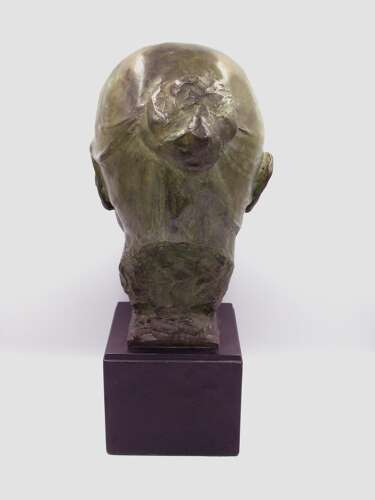


Code: CN3
Dimensions:
Sir William Reid Dick K.C.V.O., R.A. (British 1879–1961) “Granny”. Bronze with a variegated green patina, mounted on a black socle, unsigned (see provenance below).
Measurements:
Height: 29cm (11.5in) bronze only (41cm (16in) high including socle).
Weight: 13.8kg (30.4lbs).
Notes: This is a superb, bewitching, and powerful work with immaculate provenance. The colour appears to change in different lights, as does her expression when viewed from different angles.
Provenance: Exhibited Royal Academy 1960. Bought from there by the previous owner, Mr Ronald Peatfield FRCS. Documentary evidence included: Royal Academy Illustrated Catalogue 1960 (in which this bronze is illustrated, page 85); The original receipt from the Royal Academy, dated 7.6.60, for £157.60 (£3,103 in today’s money!). Two original letters from the artist to Mr Peatfield, concerning the purchase, both signed.
Condition: Excellent. There is one small chip to a bottom corner of its socle.
Biography: Sir William Reid Dick (1879–1961) was born on 13 January 1879 in Glasgow where, at the age of twelve, he was apprenticed to Scott and Rae, stonemasons. For the next five years he learned to carve stone, while attending drawing and modelling classes at night school. In 1899, while employed as a carver with a firm of stone decorators, he began night classes at the Glasgow School of Art, receiving his diploma in 1907. He had a short-lived posting teaching art at Bell's Hill Academy in Glasgow but by 1908 had moved to London, when he exhibited for the first time at the Royal Academy (RA).
In London, Reid Dick began working as a studio assistant for E. Whitney Smith (1880-1952) at the same time as taking evening classes at the Kennington School of Art. Following a commission for a portrait in marble of Harry Lauder (exhibited RA, 1911). He became an associate of the Royal Society of British Sculptors in April 1915, was elected fellow in August 1923, won the society's silver medal in 1928, and was its president from 1933 to 1938. In 1918, his bronze mask Androdus was bought for the Chantrey collection (exh. RA, 1919; Tate collection) and in 1921 he was elected an associate of the Royal Academy, and a member in 1928.
Reid Dick's monumental sculpture included Memorials at Bushey and Rickmansworth, Hertfordshire (1921), the Kitchener memorial chapel (1922–5) in St Paul's Cathedral, London, an eagle for the Royal Air Force memorial, Westminster, the lion for the Menin Gate at Ypres, Belgium (1927) and individual memorials to David Livingstone at Victoria Falls, Zimbabwe (model exh. RA, 1934), George V in Westminster Abbey (models exh. RA, 1939 and 1941), President Franklin Delano Roosevelt in Grosvenor Square, London (1948; study exh. RA, 1949), and Lady Godiva in Coventry (model exh. RA, 1950).
His architectural works include bas-reliefs for Selfridges, Oxford Street, London (1928); 'Controlled Energy', for Unilever House, Blackfriars, London (1932); figures for St Andrew's House, Edinburgh (1939); and the bronze Herald for the Reuters Building in Fleet Street, London (model exh. RA, 1939). His reputation for portraits began with a marble mask of Lady Diana Duff Cooper (exh. RA1922). A bust of George V (1933) was the first of fourteen royal portraits exhibited at the academy. Other notable sitters included Winston Churchill (bronze, exh. RA, 1943). During his lifetime, he exhibited a total of 163 works at the Royal Academy.
Reid Dick was created KCVO and was appointed sculptor-in-ordinary for Scotland by George VI in 1938 and became an honorary Royal Scottish Academician in 1939. He made numerous memorials to George V, Queen Mary, and George VI at the royal residences at Windsor, Balmoral, and Sandringham. He was a trustee of the Tate Gallery (1934–41), a royal fine arts commissioner (appointed 1938), and a chairman of the sculpture committee for the London Olympic games in 1948. In 1933 he was made an honorary fellow of the Royal Society of Arts, receiving the society's Albert medal in 1948 for ‘National Memorials in Living Stone’.
William Reid Dick died at his home, 16 Maida Vale, London, on 1 October 1961. On 17 October 1963 a memorial tablet was unveiled in the crypt of St Paul's Cathedral during a service attended by many artists and architects. The president of the Royal Academy, Sir Charles Wheeler, gave the oration.
(Source: Sarah Crellin's excellent biography of the artist in The Oxford Dictionary of National Biography)
Shipping is free for UK, EU, Canada, USA. For any other destinations, please request a quote.

