PHONE: 07772174440
EMAIL: info@lefays.com


Code: 510
Dimensions:
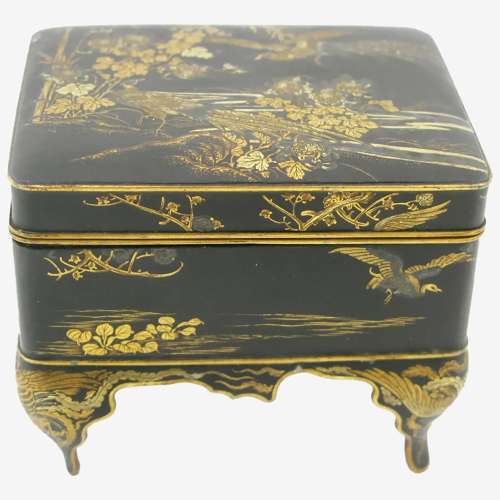
Fujii Damascene Co, c.1930. Etched brass. Fujii Damascene Co mark to base. Finely etched with scenes of birds, water, and foliage.
We found part of a paper ticket between the inner and outer bases. See the last 2 images, which are of each side.
Height: 2.75in (7cm)
Width: 3.5in (9cm)
Depth: 2.75in (7cm)
Condition: Good. Some wear and small scuffs but commensurate with age. One leg bent slightly inwards. Some etched parts of birds and flowers appear black.
Shipping: Free to most destinations. If your destination does not show free shipping, please ask.
Biography: Fujii Yoshitoyo was born in Kyoto, Japan in 1868. A metal worker of the first rank, he came from four generations of producers of inlaid work, dating back to the 17th century. An innovator who was inhibited by unwillingness to consider changes to traditional methods in Kyoto, he moved to Tokyo, where he succeeded in introducing improvements to the technique.
In 1902, at the age of 35, Fujii obtained his first patent from the Imperial Government. In 1909 he was granted his second patent. His damascene work, being made mostly from designs drawn by Prof. Bisei Unno of the Tokyo Fine Art School, well met the taste and requirements of the time. He was awarded first-class medals for many exhibitions and his work was purchased by the Imperial Household, considered a great honour. He exhibited at the Japan-British Exhibition held in London and at the Tokyo Taisho Exhibition in Tokyo in 1914.
We found part of a paper ticket between the inner and outer bases. See the last 2 images, which are of each side.
Fujii Yoshitoyo was born in Kyoto, Japan in 1868. A metal worker of the first rank, he came from four generations of producers of inlaid work, dating back to the 17th century. An innovator who was inhibited by unwillingness to consider changes to traditional methods in Kyoto, he moved to Tokyo, where he succeeded in introducing improvements to the technique.
In 1902, at the age of 35, Fujii obtained his first patent from the Imperial Government. In 1909 he was granted his second patent. His damascene work, being made mostly from designs drawn by Prof. Bisei Unno of the Tokyo Fine Art School, well met the taste and requirements of the time. He was awarded first-class medals for many exhibitions and his work was purchased by the Imperial Household, considered a great honour. He exhibited at the Japan-British Exhibition held in London and at the Tokyo Taisho Exhibition in Tokyo in 1914.